

What a 2025 Stanford study taught us about bringing AI into the home care office, and how staff roles change when you do.
By Daniel Tian, Co-Founder, President & CTO, Zingage
Most agencies start with AI the same way. They ask the office team what they would like to hand off, and they buy a tool for that.
A 2025 Stanford study suggests that is the wrong place to start.
Researchers at Stanford asked 1,500 U.S. workers in 104 occupations which of their tasks they would like an AI agent to handle, 844 tasks in all. Then they asked 52 AI experts which of those same tasks AI can actually do well today. They called the dataset WORKBank.
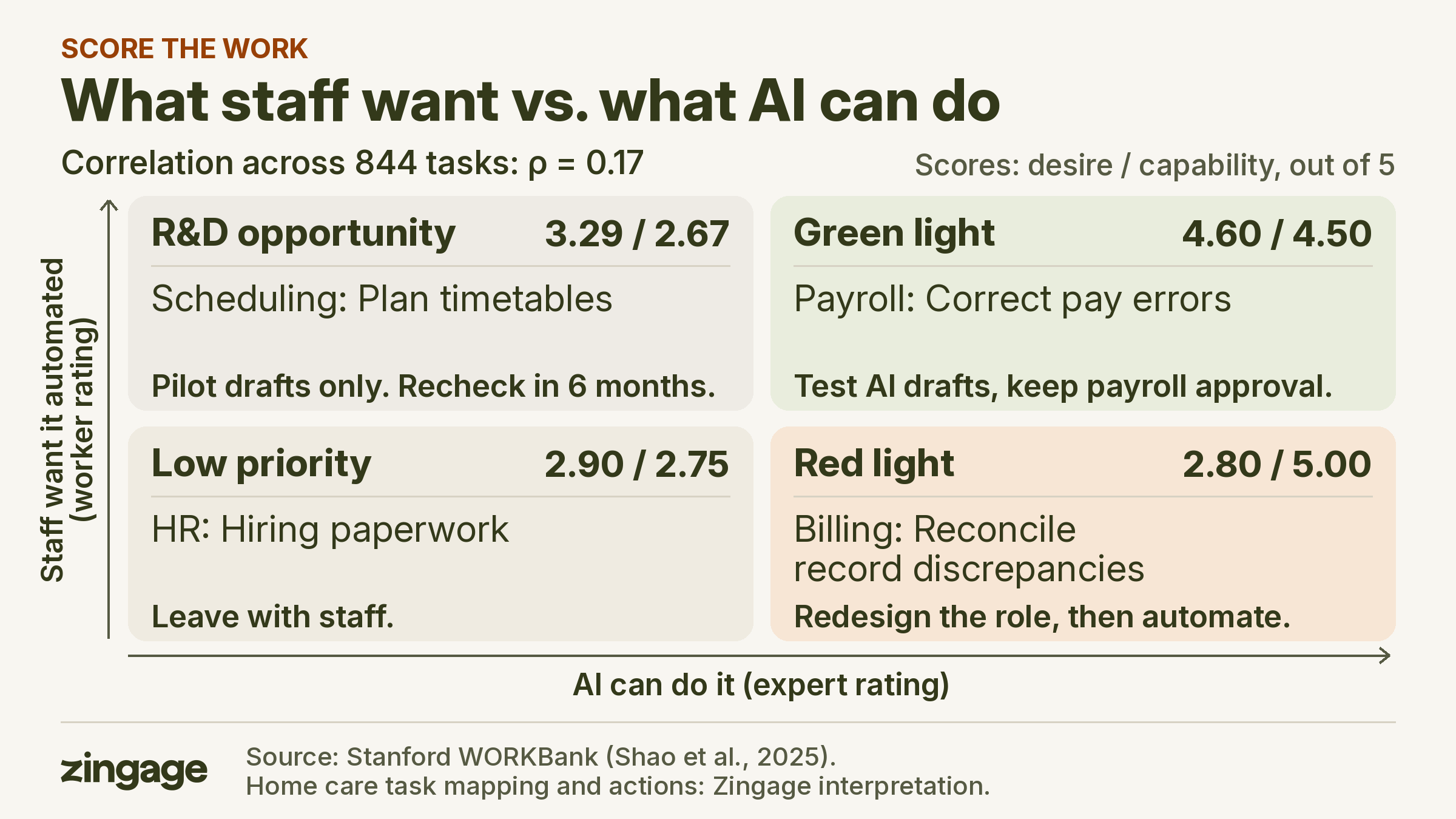
The two lists barely matched. Across the study, the correlation between what workers wanted and what AI could do was 0.17, where 1.0 would mean they matched perfectly.
We build AI agents for home care, so we pulled the 110 tasks from ten occupations closest to home care office work, like scheduling, billing, payroll and HR. What follows is our reading of that data for home care. Stanford did not study home care agencies directly.
What agentic home care means
Agentic home care means AI agents do the routine work of running an agency, inside rules the agency sets. Staff handle the exceptions, the approvals that need a person, and every clinical decision.
Think of a normal week: a call-off before a morning shift, timesheets to match against EVV before payroll, a caregiver's question at 10 p.m. In an agentic agency, agents handle the routine version of each. Your team steps in when something is unusual.
Not every part of the office is ready for the same amount of help. In our illustrative model, the work falls into three groups:
- Fully automate: client and caregiver communication, after-hours on-call, EVV and timesheets, payroll, and compliance and credentialing. Agents can take on most of this work.
- Mostly AI: scheduling and call-offs, recruiting and onboarding, and billing, AR and authorizations. Agents do much of the work, and staff review more of it.
- Assist: intake and referrals. This stays with your team. Agents help, but the relationship with the discharge planner and the family is the job.
Why owners should care
Most office time goes to keeping existing care running: schedules, call-offs, EVV, claims and payroll. We call that maintenance. Very little goes to growth: working referrals, starting care, recruiting and keeping caregivers and clients.
In our illustrative model of an agency with 25,000 weekly billable hours and 100 office staff, maintenance takes about 80% of office time and growth about 20%. If agents take on the routine part of that maintenance work, the same team frees about 1,860 hours a week. Growth time rises from 800 to 2,660 hours a week, which is 3.3× more time for growth, with no cut in headcount.
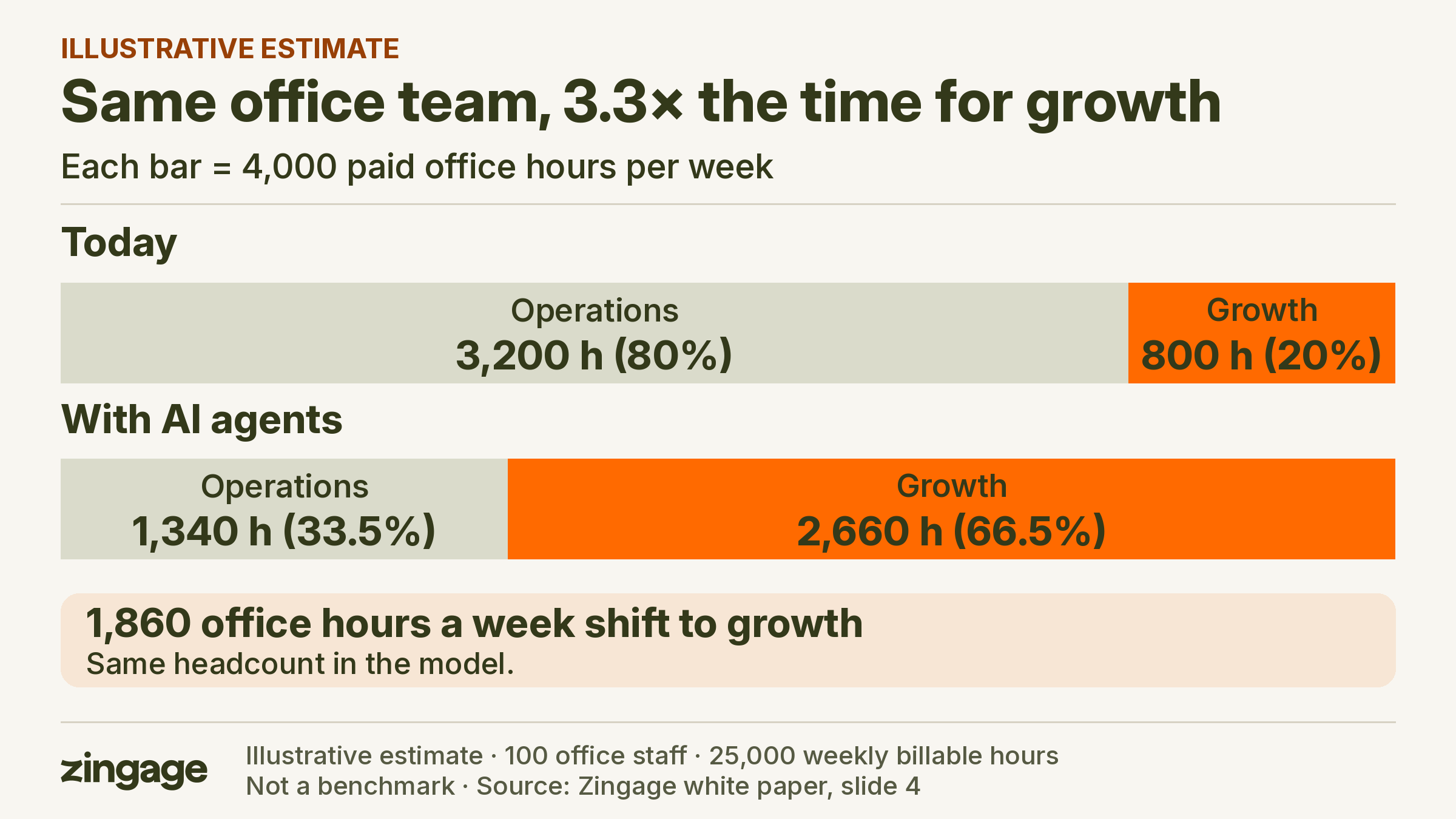
Then you face a choice. You can cut payroll, or you can keep your team and point the freed time at growth. In our illustrative single branch (2,500 weekly billable hours, 10 office staff), cutting saves about $315,000 a year. Keeping all ten staff pays off once the branch adds about 612 weekly billable hours. If the branch doubles its hours, it is worth about 2.3× more by year three, at the same sale multiple.
Listen to your staff, but don't let a survey decide
Your team's input matters. They know where the work hurts, and they will work alongside the agents. But the Stanford data shows that what people want automated is not a reliable guide to what AI can do.
Here are three examples from the study, matched to agency roles:
- Payroll: correcting pay errors. Workers wanted this automated (4.6 out of 5), and experts said AI can do it (4.5). Use AI drafts here and keep a person approving payroll.
- Billing: reconciling discrepancies in records. Workers were lukewarm (2.80), but experts rated AI at 5.00. If you go by the survey, you skip one of the best places to start.
- Scheduling: planning timetables. Workers wanted it gone (3.29), but AI isn't ready (2.67). If you go by the survey, you roll out something that breaks. Pilot drafts here and keep people booking the visits.
The study also shows what workers want from AI. In 45.2% of occupations, the top choice was an equal partnership between people and AI. The most common reason for wanting automation was "freeing up time for higher-value work," cited in 69.4% of favorable responses. Staff are not asking to be replaced. They are asking for better use of their time. So score each task on both questions, and redesign roles instead of cutting them.
How staff roles evolve
AI is not like a new scheduling screen that you train people on once. It changes the job itself. In our illustrative 10-person branch, that change happens in three phases.
Phase 1 (months 0–6): same roles, prove it's safe. Your team keeps its current jobs while agents take on routine tasks. Move on only when at least 98% of 50 sampled agent actions a week follow your policies, with no serious incidents and no drop in fill rate.
Phase 2 (months 6–18): staff own the exceptions. Jobs start to shift:
- A scheduler becomes the agent operations lead, who runs the scheduling and call-off agents, sets the rules and clears routine exceptions within a day.
- Another scheduler becomes the caregiver success manager, who owns caregiver retention.
- Intake becomes the referral growth manager, who owns discharge-planner relationships and starts of care.
- Billing and payroll become revenue integrity analysts, who supervise billing and pay agents and review denials.
- The recruiter becomes the talent pipeline owner, who closes hires while agents screen and book interviews.
Phase 3 (months 18–36): client teams own growth. Small teams of two own a group of clients end to end, with agents doing the routine work underneath. Missed visits and first-pass claim rates must not get worse.
Stanford's data points the same way: as AI takes on information processing, the skills that matter shift toward working with people. Tie pay to the new roles, with bonuses for clearing exceptions, keeping caregivers and starting care, so staff can see what they gain.
A practical example
Take a branch with 10 office staff and 400 paid office hours a week (an illustrative case). Today, about 320 of those hours go to maintenance and 80 to growth.
Picture the scheduler's morning. A caregiver calls off at 5:40 a.m., and she spends the next hour working down a phone list, updating the schedule and calling the family. With agents in place, the agent has already contacted qualified caregivers, covered the shift within your rules and confirmed with the family. Her queue holds only the exceptions, like an overtime approval or a shift nobody accepted. She clears those, then calls the caregivers most likely to leave.
Across the branch, that frees about 186 hours a week. Growth time rises from 80 to 266 hours, with the same 10 people.
How to get started
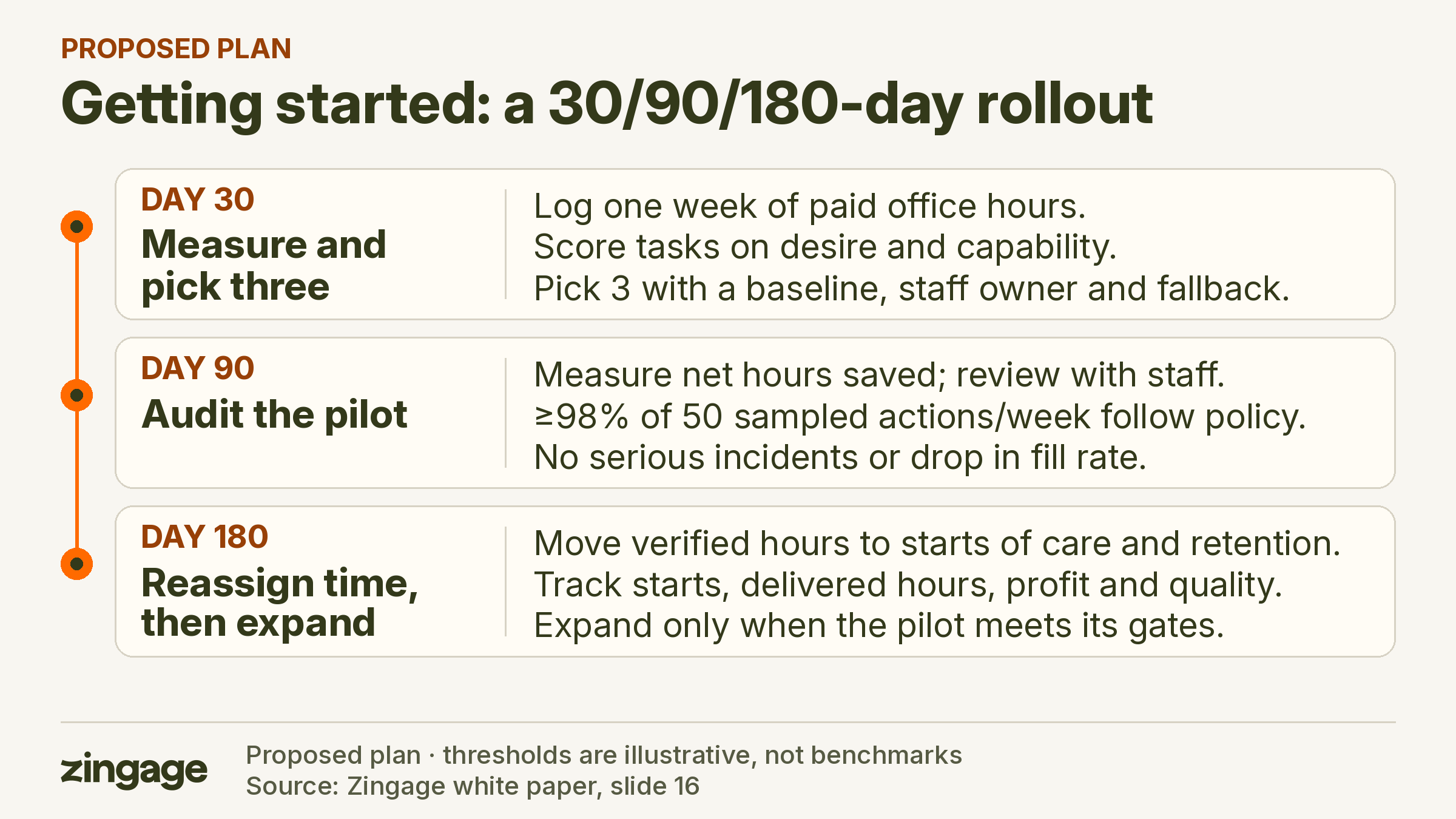
- By day 30, measure your office. Log one week of paid office hours by task. Score each task on staff desire and AI capability. Pick three tasks to start, each with a baseline, a staff owner and a fallback.
- By day 90, prove the pilot. Check that at least 98% of 50 sampled agent actions a week follow policy, with no serious incidents and no drop in fill rate. Measure the hours actually saved after review and rework, and review each task with the staff who own it.
- By day 180, put the time to work. Move verified hours into starts of care and retention. Track starts, delivered hours, profit and quality. Recheck tasks where AI wasn't ready, and expand only after the pilot meets its targets.
Let's talk
We're building this playbook with the 1,000+ agencies on Zingage. If you run a home care agency and want to score your own office against the Stanford data, or just compare notes, email me at daniel@zingage.com.